
Wall-to-wall
warehouse material flow
with voice guidance
– from goods receipt to returns
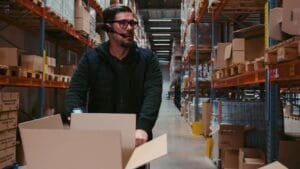
Voice-guided intralogistics
– why it belongs in your whole warehouse, not just in picking
Voice solutions are often associated only with order picking, and even then, mainly with the picker’s own speech. In reality, the biggest business impact appears when voice reaches across the entire intralogistics chain in both directions. This includes goods receipt, put-away, production picking, transfers, replenishments, inventory counting, packing, shipping and returns.
When people can keep their eyes on their surroundings and their hands free to move goods, work flows more smoothly, without paper lists or constant tapping on handheld devices. At the same time, your system collects accurate, real-time data from every step in the background, automatically.
In most real-life implementations, voice is not a stand-alone channel. It works together with barcode scanners, RFID readers and the mobile device screen. Each channel does the part where it is strongest, and the employee chooses the most natural way to work in each situation.
In this blog, we walk through practical examples of how voice guidance supports intralogistics step by step.
Voice-guided goods receipt and inspection
– getting the right goods in, the right way
Goods receipt is full of critical decisions made in a short time:
• What is arriving?
• Is the delivery correct and undamaged?
• Where should the goods go next?
With voice guidance, the system walks the user through each step: unloading, identification, inspection and confirmation into the ERP or WMS. The operator hears the instructions through the headset and can confirm by speaking – without having to hunt for the right line on paper or scroll through a device screen between scans and checks.
In practice, the solution combines voice and scanning in an efficient way. Identification is done with barcode or RFID, while voice and the mobile screen guide the user through the following steps.
This has two very concrete effects:
1. Fewer receiving errors, because items are inspected and confirmed immediately.
2. Faster availability in the system, so material is ready for picking or production right away.
Voice-directed put-away and internal moves
– hands free, stock always up to date
During put-away you decide how easily goods can be found later. With voice, the system can tell the operator where to put the goods, and the worker confirms the final location and quantity by speaking.
This reduces errors where goods end up on the wrong shelf, in the wrong level or in the wrong zone. At the same time, stock balances are updated instantly to the correct storage-location level.
The same working model fits:
• internal bin-to-bin transfers
• replenishment from main store to lines
• control of buffers and intermediate storage areas
When you know where goods actually are, both picking and production can run without unnecessary ”search tours” around the warehouse.
Voice-directed production picking
– keeping material flowing without bottlenecks
In intralogistics for production, weak process control shows up immediately: a line stops if material is not in the right place at the right time.
Voice-guided picking and line feeding help you ensure that:
- the right material is picked from the right location
- the correct quantities are delivered to the right Workstation
- material flow remains smooth without excessive buffer stocks
- leftover material is returned to stock in a controlled way
Pickers move between warehouse and production on foot or by truck. Instructions are given via headset: where to go, what to take, how much and where to deliver it. Checks can be done with a scanner, and confirmations with speech. The picker doesn’t have to keep stopping at a terminal or staring at a screen.
Different warehouse picking methods,
one voice-guided workflow
In intralogistics, you typically use several picking methods – from forklift pallet picking to carton and small-parts picking. Voice guidance adapts to these different methods without the user having to learn a completely different working logic for each.
Often the best result is achieved when voice steers the workflow, and scanner plus mobile screen handle identification and details such as batch numbers, serial numbers and exceptions.
Voice-guided forklift pallet picking
– from pallet to pallet
For forklift drivers, one of the most important tasks is to drive safely. Voice guidance reduces the need and temptation to glance at the screen while driving, and removes the need to scroll through long paper picking lists. The system provides pick routes, stopping points and quantities via audio.
With instructions coming through the headset, the driver can focus on driving and observing the surroundings. At the same time, safety improves, picking errors are reduced and picking speed goes up.
Voice-guided manual carton picking and small-parts flows
In carton and small-parts picking, employees move a lot between shelf rows and pallet locations. Smart voice guidance, often combined with multi-order (cluster) picking, reduces unnecessary walking and errors:
• the picker gets precise instructions for the next line and location
• picked quantities are confirmed by speech
• hands stay free for handling boxes, pallets and carts
This fits especially well in environments where picking lists change during the day or where seasonal peaks bring rapidly changing order combinations.
Voice-guided cluster picking and different picking strategies
Voice supports both single-order picking and batch or zone picking. The picker doesn’t have to think about the underlying picking strategy – the system optimises routes and groups order lines, while voice guides the actual work.
This way you can collect multiple orders in one pass through the warehouse, without making the picker’s job more complex.
Voice-guided packing and shipping
– final checks without paper stacks
n packing, you make the final promise to the customer: they receive exactly what was ordered. Voice supports packing and shipping, typically together with barcode scanners and on-screen checks, for example by:
• ensuring that the right products end up in the right parcel or pallet
• guiding pallet building and labelling
• helping verify that shipping labels match the correct order
The packer confirms checks by voice while their hands stay busy with packaging materials, labels and pallets. Paper lists and sticky notes disappear, and shipments leave quickly and with fewer errors.
Voice-guided returns handling and internal complaint flows – fast resolution and back to the loop
Returns and complaints can easily overload your normal processes if their handling is not clearly guided. Voice can also bring structure to these flows.
When a return arrives, the system guides the worker through documentation: what is being returned, why, in what condition and where it should go next: inspection, resale, refurbishment or recycling.
As the information is recorded automatically into the system and goods are immediately routed to the right place, return flows don’t disturb everyday operations. At the same time, the quality of complaint data improves, making it easier to find and address root causes.
Data and management
– what voice reveals about your processes
Voice-guided work automatically produces accurate, real-time data about:
• throughput times
• duration of different work steps
• error situations and exceptions
• the volume of replenishments and transfers
Supervisors and management get a much clearer view of where bottlenecks appear and which steps run smoothly. There is no need to run separate measurement projects for reporting, because the data is generated directly from daily operations.
This means intralogistics can be developed based on facts, not just gut feeling.
Phased voice solution deployment
– lowering the threshold to start talking
For Devoca customers, implementing voice guidance does not require changes to the physical warehouse or to existing core systems. You can also roll out voice in phases: first introduce one-way audio guidance, and only in the next step add the user’s spoken confirmations.
This way, voice becomes a natural part of everyday work before you move on to the most demanding part of change management; getting people comfortable with speaking to the system. The warehouse can move forward at its own pace, with each step already delivering measurable benefits to intralogistics efficiency and quality.
In Devoca’s Talk’nPick solution there are two options for using voice:
• One-way voice guidance (system → user)
• Two-way voice / speech-controlled workflow, where the user also uses their own voice to operate the system
Both are agile extensions to your existing solution – or can be configured to work from day one when you deploy Talk’nPick.
