
16.1.2026 / Mika Aalto
In many small and mid-sized companies, warehouse operations are still run using standard ERP functionality and paper printouts. As the business grows, handheld devices and scanners are introduced to improve efficiency. In practice, ERP warehouse transactions are brought digitally onto the warehouse floor, but the underlying logic remains ERP-centric and transactional. In some cases, this is still a perfectly valid way to get started with warehouse development.
Challenges arise when warehouse operations become more complex. A warehouse is no longer a single process or location, but a combination of operating models, picking methods, recurring exceptions to standard ERP logic, and often a changing workforce. When the goal is to optimize the entire internal logistics and material flow, it is worth asking whether ERP mobile usage alone is sufficient? Or whether additional usability, scalability, and intelligence are required alongside it?
Below, we outline five key differences between ERP mobile views and WMS-level operational execution.
1. Work orchestration vs. transaction recording
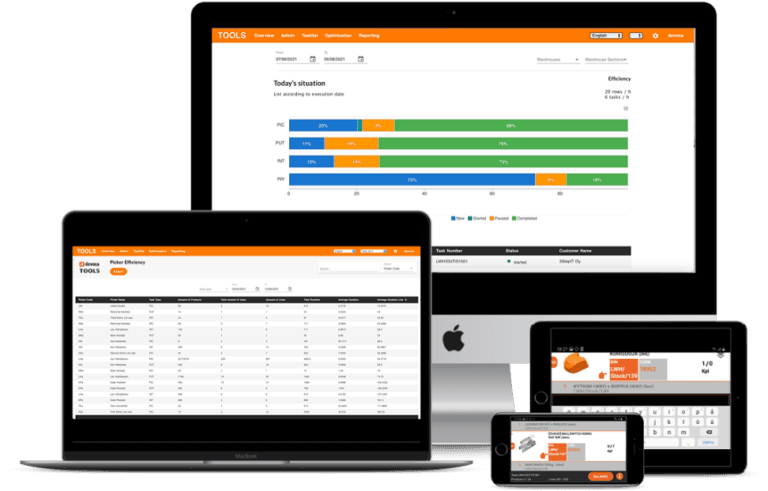
ERP mobile functionality typically works well for recording individual transactions such as receiving, movements, picking, and inventory counts. However, true warehouse productivity does not come from faster data entry alone, it comes from effective work orchestration:
• what should be done next
• in what order
• which orders should be combined
• what is the next best task
When employees no longer need to guess their next step and all warehouse activities are handled through a single tool, both efficiency and transparency improve. Internal logistics can be managed at an entirely new level.
2. Same product, different warehouses
– different operating models
ERP handheld views are often built on standardized process templates. When a company operates in multiple environments, such as wholesale picking, e-commerce fulfillment, production feeding, remote warehouses, or even 3PL, differences quickly emerge as exceptions. These are often addressed through customizations and add-ons, increasing complexity and slowing down development.
An alternative approach is to build warehouse operations on pre-tested, configurable workflows that adapt to different warehouse types without heavy customization. In this model, the warehouse becomes an enabler of business development rather than a bottleneck.
3. Exceptions are the rule, not the exception
Warehouse operations are full of situations where things don’t follow standard processes or plans:
• shortages
• inventory discrepancies
• barcode or master data errors
• wrong locations
• batch and serial number exceptions
• substitute products
• urgent orders or routes
In ERP mobile views, exceptions often lead to dead ends: go back, switch screens, or ask a supervisor. Effective operational execution guides the user through exceptions in a controlled way so work continues without disruption. At the same time, exceptions are captured as data, enabling analysis and systematic process improvement.

4. Warehouse work is not office work

When warehouses adopt handheld devices, it’s important to understand where the real differences between solutions lie. At a high level, these differences show up in areas such as:
• task duration
• error rates
• speed of onboarding
• employee satisfaction
While devices themselves vary, the biggest difference comes down to whether the system actively guides the user. Guided, multimodal interaction (voice, scanner, and keyboard when needed) enables “hands- and eyes-free” work. Compared to ERP mobile extensions, this translates into fewer steps, smoother picking, and less stress on the warehouse floor. It also enables multi-order picking, proactive bottleneck detection, and order or route prioritization.
5. The development path:
ERP mobile does not evolve into a WMS
Growing companies typically want to develop their warehouse operations step by step and spread investments over several years. For some, receiving is the priority; for others, picking speed and quality. Over time, the need might evolve toward predictive work orchestration and performance measurement.

At Devoca, warehouse development is seen as a modular and flexible journey. Standard ERP remains the foundation, and WMS-level capabilities are added alongside it incrementally. You pay only for what you need, and scaling remains fast and flexible. The alternative is heavy ERP customization and multiple add-ons that increase costs, complicate the architecture, and eventually slow down progress. Firefighting one issue at a time is often the slowest and most expensive way to develop warehouse operations. That’s why involving a warehouse management professional typically pays for itself quickly.
